

From kindergarten promotion to portrait of a graduate, give kids the know-how they need in our tech-filled world.

Making sure students are prepared for their futures has always been a goal for schools and educators, but achieving it is only getting more complicated. With the speed of AI development and its uncertain impacts on careers, it's hard to know what skills students will actually need to give them access to the jobs—and lives—they want. Even the job application process involves artificial intelligence models that pre-scan resumes and cover letters! Add to that the ways in which digital life may impact the classroom, from student behaviors to attention spans, critical thinking, and learning itself.
Despite the shortcuts that various forms of media and tech can afford us, we know that foundational knowledge and skills are essential for further learning and practical application to flourish. And, of course, there are still educational objectives and standards that schools are responsible for helping students meet. Districts are formulating portraits of graduates to meet this moment. But even as we meet current standards, media and tech are moving the targets in unpredictable ways.
Here's something we can be sure of in uncertain times: Media and tech may influence fundamental skills and capacities, but they'll never replace them. What we can do is help students recognize this influence and the deep importance of these skills and human capacities for their present and future selves.
By recognizing the role that digital literacy and well-being play in thinking and learning, we are finally including the enormous influence that media and tech have on our lives, our cultures, our relationships, and even what it means to be human. We're helping kids take back the reins and learn to think about that influence so they can shape their futures from a more informed and skilled place. We're helping them learn how to think, create, evaluate, and reflect in ways that showcase the value of their own minds and hearts.
Below you'll find each life skill supported by one or more types of applicable resources, including lessons, PD, and tips.
Digital Literacy & Well-Being
In our technology-infused world, it's increasingly important that we use media and tech for our individual good and collective benefit. That means not only recognizing the design tricks and content types that try to keep us hooked, but also forming healthy habits despite those efforts. It means being able to think critically about the motives and messages of people online and keep ourselves and our information safe. In the age of AI, it also means understanding the utility and shortcomings of artificial intelligence and new tech developments that follow. There are even more skills beyond these! But direct instruction about digital literacy and well-being is no longer nice-to-have: These skills are now critical underpinnings to so many other elements that lead to the lives we want our students to have.
AI Literacy
Building literacy and readiness for AI isn't about the specifics of prompt engineering. It's about understanding this technology that's being embedded everywhere online, whether we want to use it or not. Despite the fact that unguided AI chatbot use isn't safe for kids, they still need to learn about all forms of AI and build agency around them. Though we don't know exactly how artificial intelligence will impact our students' futures, we do know that these impacts are already in progress. It's embedded everywhere, so even if they never seek it out, they'll still encounter it. Understanding algorithms, facial recognition, deepfakes, AI search summaries, and chatbots is an emerging—and evolving—life skill that kids will need to not only enter certain careers, but also have agency around its further development and impacts.
Lessons:
- Perfectly Altered (Grade 3)
- Remix Responsibly (Grade 5)
- Giving Credit (Grade 6)
- Is It Fair Use? AI Edition (Grade 6)
- Choosing Sources (Grade 7)
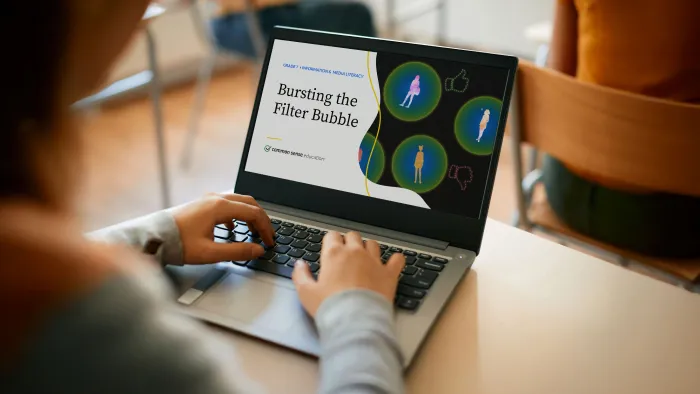
- Bursting the Filter Bubble (Grade 7)
- Facing Off with Facial Recognition (Grade 8)
- AI Chatbots & Friendship (Grade 8)
- AI Algorithms: How Well Do They Know You? (Grade 8)
- Deepfakes & Consent (Grade 8)
- Does Our AI Policy Work for Us? (Grades 9–12)
- Designed to Feel Human (Grades 9–12)
- Drifting Toward the Chatbot (Grades 9–12)
- How Does AI Learn? (Grades 9–12)
- How Your Attention Shapes You (Grades 9–12)
- Creativity: Defining What's Yours (Grades 9–12)
- Creativity: Sharing It with AI (Grades 9–12)
- How to S.I.F.T. with AI (Grades 9–12)
- Is AI a Choice or a Necessity? (Grades 9–12)
Other resources:
- Two Truths & AI game (Grades K–12)
- Teachers' Essential Guide to AI Literacy
- ChatGPT & Beyond: How to Handle AI in Schools
- AI, SEL & Well-Being
- 3 Core Human Skills to Build Before AI Use
- AI Movies, Books, and Podcasts to Discuss in the Classroom
Information & News Literacy
In addition to understanding artificial intelligence, students need to be able to think critically about the information they see online. Increasingly, it's difficult to know what's real and factual, whether AI is involved or not. Knowing how to find accurate information, recognize bias, understand the attention economy, and weed out all of the online noise will help safeguard students against easy manipulation.
Lessons:
- What Is Media? (Grade K)
- How Media Makes Me Feel (Grade K)
- Fact or Fiction? (Grade K)
- Media: What's the Purpose? (Grade 1)
- Understanding Ads (Grade 1)
- Fact vs. Opinion (Grade 1)
- Using Tech to Learn New Things (Grade 2)
- How to Search Online (Grade 2)
- Exploring Search Results (Grade 2)
- Finding the Source (Grade 3)
- Trending Now! (Grade 3)
- Media & Our Emotions (Grade 4)
- S.I.F.T. for Sources (Grade 4)
- Slicing Up Media with P.I.E. (Grade 4)
- Understanding Influencers (Grade 4)
- Spotting Media Influence (Grade 5)
- Media Frames: Looking Beyond Headlines (Grade 5)
- S.E.E.K.ing Information (Grade 6)
- Evaluating Information Online (Grade 7)
- What Is Critical Ignoring? (Grade 8)
- Telephone Trouble: Mis- & Disinformation (Grade 8)
- Critical Ignoring: What's Worth Your Attention? (Grades 9–12)
- Building Your Own Perspective (Grades 9–12)
- What's Real Online? (Grades 9–12)
- Navigating Health Advice Online (Grades 9–12)
Other resources:
Healthy Habits
Because of the always-on culture of constant news, infinite scrolling, and never-ending notifications, being able to find balance is important. But devices and content are created to keep our attention, no matter our age: If it's hard for adults to put devices down, it's easy to see why it's even harder for kids! Determining our values and aligning our device use in support of them is a great human-centered approach to creating healthy habits. Aligning tech use with our values also aids our efforts to be less influenced by every new trend or persuasive persona. Self-awareness and reflection are also key ingredients to support well-being!
Lessons:
- Saying Goodbye to Tech (Grade K)
- Media Balance Is Important (Grade K)
- Managing Device Distractions (Grade 1)
- Autoplay: Helpful or Not? (Grade 1)
- We, the Digital Citizens (Grade 2)
- Device-Free Moments (Grade 2)
- Making Healthy Media Choices (Grade 3)
- Emoji Power: Expressing Ourselves Online (Grade 3)
- Outsmarting Attention Thieves (Grade 3)
- Spotting Thinking Traps (Grade 4)
- Brain Battle Game (Grade 4)
- Healthy Tech Habits & Our Feelings (Grade 4)
- Creating Device-Free Moments (Grade 5)
- Understanding Design Tricks (Grade 5)
- Tricky Tech Game (Grade 5)
- What Is the Attention Economy? (Grade 6)
- Building Healthy Tech Habits: Part 1 (Grade 6)
- Building Healthy Tech Habits: Part 2 (Grade 6)
- Tech & Values (Grade 7)
- What Are Thinking Traps? (Grade 7)
- What Are Design Tricks? (Grade 7)
- Tech Habit Challenge: Part 1 (Grade 8)
- Tech Habit Challenge: Part 2 (Grade 8)
- App Traps & Addictive Design (Grade 8)
- Tech Habit Challenge (Grades 9–12)
- Social Comparison & Social Media (Grades 9–12)
- My Values & Tech (Grades 9–12)
- Navigating Health Advice Online (Grades 9–12)
- Parasocial Relationships: From Fan to Fiction (Grades 9–12)
- Deepfake Nudes & Consent (Grades 9–12)
- Design Tricks (Grades 9–12)
- Thinking Traps & Alternative Thoughts (Grades 9–12)
Other resources:
- Modeling Healthy Digital Habits (PD training course)
- When Families Ask About Activities to Boost Digital Literacy & Well-Being
- When Families Ask About Healthy Digital Habits & Quality Content
- 23 Great Books to Boost Digital Literacy & Well-Being
- Offline Digital Citizenship: Soft Skills to Support Strong Online Habits
Civic Engagement
If young people can discern accurate information, are in touch with their values, and practice habits that support their well-being, they're in a better position to be connected to their communities. That connection, in conjunction with their values and healthy habits, can also translate into civic engagement. To participate in democracy as a well-informed citizen, kids need all of the skills mentioned above.
Lessons:
- Civic and Digital Literacy lesson collection (Grades 3–8)
Other resources:
- Social and Cultural Literacy Resources for Classrooms
- Still Human: Educating for Democracy in the Age of AI (recorded webinar)
- Learning from Conflict: Discussing Controversial Issues in the Classroom
- Books About Elections and Voting
- iCivics
Cybersecurity
One underestimated piece of engaging with our communities is cybersecurity. Since so much discourse happens online, sharing links and posts that are part of a social engineering scam or that contain malware can have direct impacts on organizations and communities. Protecting our own information is also an increasingly important life skill as technology—including tech used by criminals—becomes more sophisticated. Understanding what personally identifiable information (PII) is, when and how to share or not share it, and thinking carefully before potentially endangering others' privacy are all skills that kids need. Plus, in the age of AI, cybersecurity is a growing industry—for humans!
Lessons:
- Cybersecurity lesson collection (Grades K–8)
- Doxxing: Know Your Risk (Grades 9–12)
- Hacking You: Social Engineering & AI (Grades 9–12)
Other resources:

Goal Setting, Focus & Executive Functioning
Though school has always assumed some level of executive functioning skills in students, digital distractions can make many of the elements more difficult. However, learning to plan, focus, and execute tasks—even when difficult—is essential to facing life's challenges. As our online worlds become more engaging, it can be harder to pull ourselves away. And that's by design. But teaching students explicitly, not only about design tricks and the attention economy, but also about developing and nurturing their own executive functioning (and why it's so important), can help bring this implicit shift into sharper focus.
Lessons:
- Managing Device Distractions (Grade 1)
- Outsmarting Attention Thieves (Grade 3)
- Understanding Design Tricks (Grade 5)
- What Is the Attention Economy? (Grade 6)
- Tech & Values (Grade 7)
- What Are Design Tricks? (Grade 7)
- What Is the Attention Economy? (Grade 6)
- App Traps & Addictive Design (Grade 8)
- What Is Critical Ignoring? (Grade 8)
- Critical Ignoring: What's Worth Your Attention? (Grades 9–12)
- How Your Attention Shapes You (Grades 9–12)
- Design Tricks (Grades 9–12)
- My Values & Tech (Grades 9–12)
Other resources:
- Decrease Digital Distraction and Elevate Attention Spans
- Offline Digital Citizenship: Soft Skills to Support Strong Online Habits
Financial Literacy
Managing money isn't always a focus of standard school curricula, even though it's an essential life skill. Increasingly, digital spaces are huge drivers of how kids view making money—and spending it. You'll definitely have students who dream of being an online celebrity with tons of brand deals, and some kids may hear their favorite influencers talk about day trading and crypto. Online gambling and prediction markets, meme cryptocurrency coins, and microtransactions in games are just a handful of iffy online financial arenas heavily advertised to kids. It's even possible to create an AI agent that manages investments for you! And then there are social media spending traps and in-game currencies. These factors make it even more critical to help students make sense of managing money in realistic, healthy ways.
Lessons:
- Spending Traps (Grades 9–12)
- Making a Living in the Creator Economy (Grades 9–12)
- Wanna Bet? The Betting Playbook (Grades 9–12)
- Loot Boxes and the Cashless Effect (Grades 9–12)
Other resources:
Friction Tolerance, Patience & Perseverance
In an age when you can get so many things instantly—including answers for assignments—it's hard to make the argument to kids that they need to do it the hard way. We know, as adults, that learning patience and persistence is important, not only because brain science tells us so, but also because we have life lessons we can point to. And we know that there are challenges in life that take grit to get through, and that no digital device can solve for us. Having the tolerance to adapt, be flexible, and persist is only becoming more valuable. As our economy becomes more and more about reducing friction, adults have to teach these skills in all the contexts they can: at home, in the classroom, in athletics, in the arts, in relationships, etc. (See below for relationship-specific resources.)
Lessons:
- Device-Free Moments (Grade 2)
- Creating Device-Free Moments (Grade 5)
- Tech & Values (Grade 7)
- Designed to Feel Human (Grades 9–12)
- Drifting Toward the Chatbot (Grades 9–12)
- Building Your Own Perspective (Grades 9–12)
- My Values & Tech (Grades 9–12)
Other resources:
- Offline Digital Citizenship: Soft Skills to Support Strong Online Habits
- Movies That Promote Perseverance
- TV That Promotes Perseverance
- Books That Build Self-Esteem
- Movies That Inspire Courage
Human Capacities
On screens, the line between AI and humans has blurred. People seek advice from and form attachments to AI chatbots. A bot can write your emails. You can even create a perfect likeness of yourself that can speak with your voice. But as the living, breathing mammals we are, there's an essential humanness that AI can't replicate. Though it's hard to quantify, there are four central capacities that are important to emphasize and foster for kids' future well-being. In terms of careers, some would argue that employers will highly value these capacities in a world of AI integration.
Connection
In-person communication and belonging are central to our well-being as humans. Social interaction and collaboration can also boost learning. And while connection can, and does, happen online, there's no substitute for being physically together with other humans (as the pandemic underlined). As mentioned above, grappling with the normal friction in human relationships is a skill we need to build, especially as chatbots offer conflict-free communication. Dealing with conflict( that develops on- or offline) and mending friendships are also essential for human connections (and can improve school culture as well). Plus, the parasocial relationships that can feel like true connection can be confusing for kids.
Lessons:
- Why We Pause for People (Grade K)
- Choosing Kindness (Grade K)
- How Tech Connects Us (Grade 1)
- Words Can Help or Hurt (Grade 1)
- Step In, Step Out (Grade 1)
- Dealing with Online Meanness (Grade 2)
- Sincere Apologies (Grade 2)
- Resolving Conflicts Online (Grade 3)
- When Words Hurt Online (Grade 3)
- Need Space or Repair? Handling Online Hurt (Grade 3)
- Is It Just a Joke? (Grade 3)
- Communicating Clearly Online (Grade 4)
- Group Chat Dynamics (Grade 4)
- M.E.N.D.ing Friendships (Grade 4)
- Friends vs. Followers (Grade 5)
- M.E.N.D. to Rebuild Trust (Grade 5)
- Communicating Personal Boundaries (Grade 5)
- Navigating Online Friendships (Grade 5)
- Making Things Right: Repairing Harms (Grade 6)
- Parasocial Relationships (Grade 7)
- Friendships & Boundaries (Grade 7)
- Boundaries & Consent (Grade 7)
- Social Norms & Tech (Grade 8)
- AI Chatbots & Friendship (Grade 8)
- S.T.A.N.D. Up to Support Friends (Grade 8)
- Designed to Feel Human (Grades 9–12)
- Drifting Toward the Chatbot (Grades 9–12)
- Dating Culture & Recognizing Pressure (Grades 9–12)
- Parasocial Relationships: From Fan to Fanatic (Grades 9–12)
- What's the Move? Responding to Online Conflict (Grades 9–12)
Other resources:
- Building Authentic Relationships in an AI-Driven World (recorded webinar)
- Books That Teach Empathy
- Books About Friendship
- Books to Help Kids and Tweens Understand the Importance of Consent
- Books to Help Teens Understand the Importance of Consent
Creativity
Expressing ourselves, making things with our hands, and using our imaginations are all uniquely human experiences. And doing these things in combination with social connection? Amazing! Aside from the excitement and satisfaction that can come with creation, human innovation often comes from wildly imaginative ideas, with unexpected synapses firing along new pathways. And while AI can take apart and reassemble the products of human creation, it has no unique combination of background experiences, passions, relationships, heartaches, and sensory inputs to alchemize into being.
Lessons:
- Remix Responsibly (Grade 5)
- Giving Credit (Grade 6)
- Is It Fair Use?: AI Edition (Grade 6)
- Creativity: Defining What's Yours (Grades 9–12)
- Creativity: Sharing It with AI (Grades 9–12)
Other resources:
Critical Thinking
There's a lot of discussion around kids and critical thinking skills, and with good reason: It's an essential skill! It's also a term that's applied in myriad ways. First, there's information and media literacy. Especially with information coming at us from every direction, we need to approach it all skeptically, and think about it critically. But what does that mean, exactly? In many cases, it's about truth vs. fiction, and fact vs. opinion. Sometimes that's clear, but often, it takes some media literacy sleuthing to determine what's accurate. It can also mean ignoring stuff! With so much low-quality content and manipulative information, we want kids to discern what should truly earn their valuable attention! Outside of the media literacy realm, kids also need to learn how to analyze information, synthesize it, and contextualize it. They also practice the very human skills of reflection and iteration to problem-solve and adjust as they go.
Lessons:
- What Is Media? (Grade K)
- Fact or Fiction? (Grade K)
- Media: What's the Purpose? (Grade 1)
- Understanding Ads (Grade 1)
- Fact vs. Opinion (Grade 1)
- Pause & Think Online (Grade 1)
- Autoplay: Helpful or Not? (Grade 1)
- Using Tech to Learn New Things (Grade 2)
- Exploring Search Results (Grade 2)
- Trending Now! (Grade 3)
- S.I.F.T. for Sources (Grade 4)
- Slicing Up Media with P.I.E. (Grade 4)
- Understanding Influencers (Grade 4)
- Spotting Media Influence (Grade 5)
- Media Frames: Looking Beyond Headlines (Grade 5)
- Understanding Design Tricks (Grade 5)
- S.E.E.K.ing Information (Grade 6)
- Evaluating Information Online (Grade 7)
- What Is Critical Ignoring? (Grade 8)
- Critical Ignoring: What's Worth Your Attention? (Grades 9–12)
- Building Your Own Perspective (Grades 9–12)
- What's Real Online? (Grades 9–12)
- Navigating Health Advice Online (Grades 9–12)
Other resources:
Curiosity
We often talk about helping students become "lifelong learners." In order to do that, we have to foster their innate curiosity about the world (among other things). But there's the "certainty trap" to consider: Kids witness everyone getting notifications and answers to everything from devices. All the time. To them, it's easy to get any answer with a search, voice assistant, or chatbot. But we also want them to read, listen to, and experience things to dig into topics and connect dots for themselves. And while tech can make it seem like the world is finite and everything is known, new discoveries of all kinds are made every single day! Offering kids opportunities to feel a sense of wonder and pursue their passions can reinforce that they might make the next cool discovery!
Lessons:
- Curiosity Tellers (Grade 1)
- Using Tech to Learn New Things (Grade 2)
- How to Search Online (Grade 2)
- Exploring Search Results (Grade 2)
- Finding the Source (Grade 3)
- S.I.F.T. for Sources (Grade 4)
- Choosing Sources (Grade 7)
- Evaluating Information Online (Grade 7)
- The Assumptions We Make (Grade 7)
- What We See, What We Assume (Grade 8)
Other resources: